---
title: "Collection projection"
slug: "core-collection-projection"
updated: 2026-05-19T09:01:03Z
published: 2026-05-19T09:01:03Z
canonical: "docs.lobstersoftware.com/core-collection-projection"
---
> ## Documentation Index
> Fetch the complete documentation index at: https://docs.lobstersoftware.com/llms.txt
> Use this file to discover all available pages before exploring further.
# Collection projection
> [!NOTE]
> Projection – Abstract
>
> **Purpose:** Collects values for the **Property of collection** and integrates them into the search via the **Property to join**.
>
> > [!TIP]
> > Tooltip
> >
> > - **Usage**: A [Collection projection](/v1/docs/en/core-collection-projection) returns a list of values from the projection in the **Property of collection** parameter, which have a relationship to the search defined via the **Property to join** parameter.
> > - **Parameter**:
> > - The **Name** field optionally defines the title of an output column (if relevant). By default, the *name* is taken from the projection for the **Property of collection**.
> > - The selection **Property to join** (default: `id`) defines the path to a *key field* that controls how subsets of the collected values are included in the search as lists.
> > - The *Projection* configured as a **Property of collection** provides the values that are to be "collected" and included in the search as a list.
> > - **Note:** The order of the entries within the list provided by [Collection projection](/v1/docs/en/core-collection-projection) is "unsorted" and cannot be controlled by configuration.
> > - **Note:** The *collection* suppresses `$null` values from the projection in the **Property of collection**
> >
> > parameter.
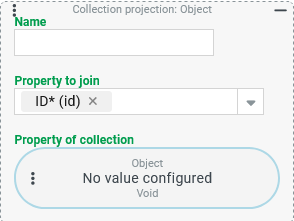
A [Collection projection](/v1/docs/en/core-collection-projection) returns a list of values from the *projection* in the **Property of collection** parameter, which have a relationship to the search defined via the **Property to join** parameter.
- If the *projection* configured as a **Property of collection** returns "no value" (`$null`), no entry is added to the *collection*. The collection may therefore contain fewer entries than the data source provides for the **Property to join**. This characteristic corresponds to that for the [Collect values](/v1/docs/en/core-collect-resolver) resolver.
> [!NOTE]
> **NOTE:**
>
> - Because the *collection* ignores `$null` values, a [Case projection](/v1/docs/en/core-case-projection) can be useful in the context of the configuration for the **Property of collection** in order to achieve the following goals (possibly simultaneously):
> - Instead of a `$null` value in the original data, a specific replacement value can be assigned that identifies "empty spaces" (or *undefined* values) within the collection.
> - Conversely, specific values can be replaced by "no value" (`$null`) depending on a condition, so that the *collection* only lists a subset of the values that are actually available.
As a default, the property "ID" (`id`) is preset as the **Property to join**, as the [Collection projection](/v1/docs/en/core-collection-projection) is typically used to collect data that is directly related to the entity being searched for.
In order to "collect" the values for the collection, an additional database query is performed internally, which lists the values for the **Property of collection** in conjunction with key values for the **Property to join**. From this "master collection", a specific subset is assigned to each entity in the search as a value list via the **Property to join**.
---
**IMPORTANT:** The query executed in the context of the [Collection projection](/v1/docs/en/core-collection-projection) to "collect" values takes place without regard to access restrictions that would apply in the context of a direct search for the same data. Therefore, internally (as with a fully-fledged join) there is full access to all instances of the entity being searched for.
What does this mean?
- As long as the default value "ID" (`id`) is selected for the **Property to join** or there is no selection, this is not critical, as the [Collection projection](/v1/docs/en/core-collection-projection) effectively only "delivers" data from instances of the entity being searched for that could also be retrieved directly.
- If a **Property to join** other than "ID" (`id`) is selected, the [Collection projection](/v1/docs/en/core-collection-projection) can also "reveal" data from instances for which there is no direct access but a relationship to a retrievable entity via the **Property to join**.
Example: A search for [Companies/Clients](/v1/docs/en/base-company-account) uses a [Collection projection](/v1/docs/en/core-collection-projection) in which the "owner" (`ownerId`) property is selected as the **Property to join**. For each directly retrievable company, values (from the projection defined as a **Property of collection**) are then assigned as a list that were collected in connection with *any* company that has the same "owner" as the directly retrievable company (see "Examples" below for more details).
---
## Configuration
| Parameter | Type | Description |
| --- | --- | --- |
| **Name** | `String` | The optional **Name** parameter can be used to assign an (alias) name to the projection. - If no **Name** is specified, the name applicable to the **Property of collection** is passed through as the column name (if relevant). |
| **Property to join** | `String` `(Selection field)` | The **Property to join** determines which field is used to integrate the values provided as a *collection* into the context of the search. The **Property to join** parameter defines a *path* to a field as a character string that can be specified by *direct input* or selection from the dropdown (for details, see [Property projection](/v1/docs/en/core-property-projection), "Property" parameter). If no selection is made for the **Property to join**, the "ID" (`id`) property is used. This property is also set as the default value. |
| **Property of collection** | *Projection* | Any [Projections](/v1/docs/en/core-i-search-projection) can be used for the **Property of collection** parameter. The *projection* determines which values are collected and then assigned via the **Property to join** in the context of the search. |
## Examples
### Simple example: Listing the assigned roles per user
A tuple search for [Users](/v1/docs/en/base-user) should output a list of the [Roles](/v1/docs/en/base-role) assigned in the user account for each user in connection with the "Username" (`username`) property.
Configuration:
| The screenshot shows the configuration for the tuple search [Projections](/v1/docs/en/core-i-search-projection): - The [Property projection](/v1/docs/en/core-property-projection) returns the text value in the "Username" (`username`) **Property**. - The [Collection projection](/v1/docs/en/core-collection-projection) should list the assigned roles: - We retain the default "ID" (`id`) as the **Property to join**. - We select the "Roles" (`roles`) list field as the **Property of collection**, in which the user account references the assigned [Roles](/v1/docs/en/base-role) via their ID values (`Long`). **NOTE:** We do not make explicit assignments for the **Name** parameter in both [Projections](/v1/docs/en/core-i-search-projection), so that the `username` and `roles` property names identify the columns. | 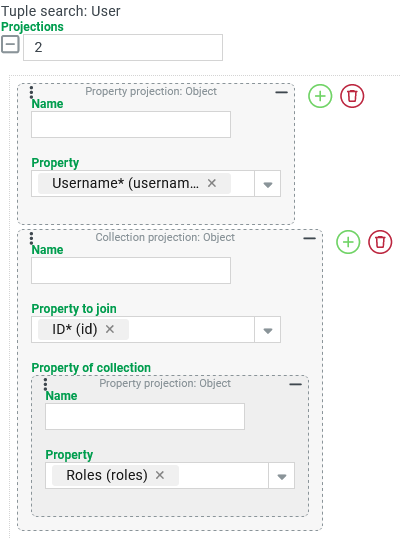 |
| --- | --- |
Runtime example:
| In addition to the text value (`username`), the result of the tuple search (right) shows a list value (`roles`) that references a different selection of roles for different [Users](/v1/docs/en/base-user) via `Long` values. The [Roles](/v1/docs/en/base-role) assigned to each user are assigned to them. **NOTE:** The user account itself does not provide any more information about the role. Detailed role data could be included via [Entity join](/v1/docs/en/core-entity-join) and then also taken into account in the [Collection projection](/v1/docs/en/core-collection-projection) per **Property of collection**. **NOTE:** The XML format also makes it clear that the order of the `entry` elements for list entries appears "unsorted". In fact, there is also no option to sort the values collected in a *collection column* within the query. If necessary, the result must therefore be edited afterwards, if possible. | ```xml username roles - adent
- 1401 501
- Q
- 1001 1 501 1201 ...
... ``` |
| --- | --- |
## Simple example: Listing all users with the same owner
A tuple search for [Users](/v1/docs/en/base-user) in connection with the "username" (`username`) field should display a list of usernames of all users whose accounts refer to the same company account as "owner" (`ownerId`) as the user in question.
| The screenshot on the right shows the [Projections](/v1/docs/en/core-i-search-projection) for a tuple search: - The [Property projection](/v1/docs/en/core-property-projection) returns the "username" (`username`) property of *one* user (per line). - The [Collection projection](/v1/docs/en/core-collection-projection) refers to the same "user" (`username`) property per [Property projection](/v1/docs/en/core-property-projection) in the **Property of collection** parameters. - The "Owner" (`ownerId`) property is selected as the **Property to join**, which differs from the default. - The **Name "**SAME_OWNER" refers to the content of the *collection*. | 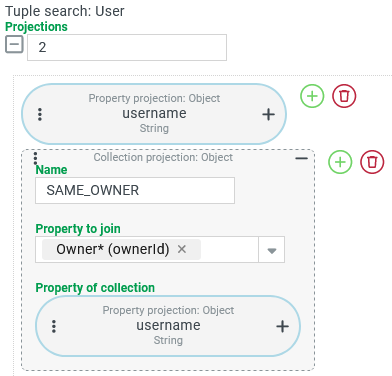 |
| --- | --- |
Runtime example:
| The result of the tuple search (right) shows a list value (`SAME_OWNER`) in addition to the text value (`username`), which specifies the names of all [Users](/v1/docs/en/base-user) for which the "owner" company of the user is also considered the "owner". **NOTE:** As the example data should illustrate, the user name output in the `username` column always appears in the *collection* as well. This cannot be prevented in the context of the [Collection projection](/v1/docs/en/core-collection-projection), as the configuration does not provide any secondary conditions for the assignment of the collected data apart from the **Property to join**. However, the [Collection projection](/v1/docs/en/core-collection-projection) can be used to ensure that *only* user names other than the one in the `username` column appear in the `SAME_OWNER` column. The following more complex example shows how this works. | ```xml username SAME_OWNER - bbanner
- pparker bbanner srogers ...
- bwayne
- bwayne ckent acurry ...
... ``` |
| --- | --- |
### More complex example: Listing all other users with the same owner
Deviating from the previous example, the aim is to ensure that the "username" output in the `username` column is not mentioned again in the associated list in the `SAME_OWNER` column. So the list should have all *other* users with the same "Owner" company (`ownerId`).
Configuration:
| Since no arbitrary conditions for the assignment of the collected data can be formulated within the [Collection projection](/v1/docs/en/core-collection-projection), we have to set up a [Entity join](/v1/docs/en/core-entity-join) in our search, which explicitly serves to identify the *other* users with the same owner. The [Entity join](/v1/docs/en/core-entity-join) is configured as shown on the right: - The entity type "User" is selected as **Entity**. - The abbreviation `u2` was arbitrarily assigned as the **Join alias** here, - The **On** condition checks two criteria in an AND conjunction: - The first [Field restriction](/v1/docs/en/core-property-search) (`id!=u2.id`) prevents the *main user* from being returned as the `u2` user.This criterion defines the *secondary condition* that could not be configured *within* the [Collection projection](/v1/docs/en/core-collection-projection) in the previous example. - The second [Field restriction](/v1/docs/en/core-property-search) (`ownerId==u2.ownerId`) requires that all `u2` users must have the same "Owner" as the *main user*.This criterion corresponds to the property selection of "Owner" (`ownerId`) as the **Property to join** in the [Collection projection](/v1/docs/en/core-collection-projection) in the previous example. | 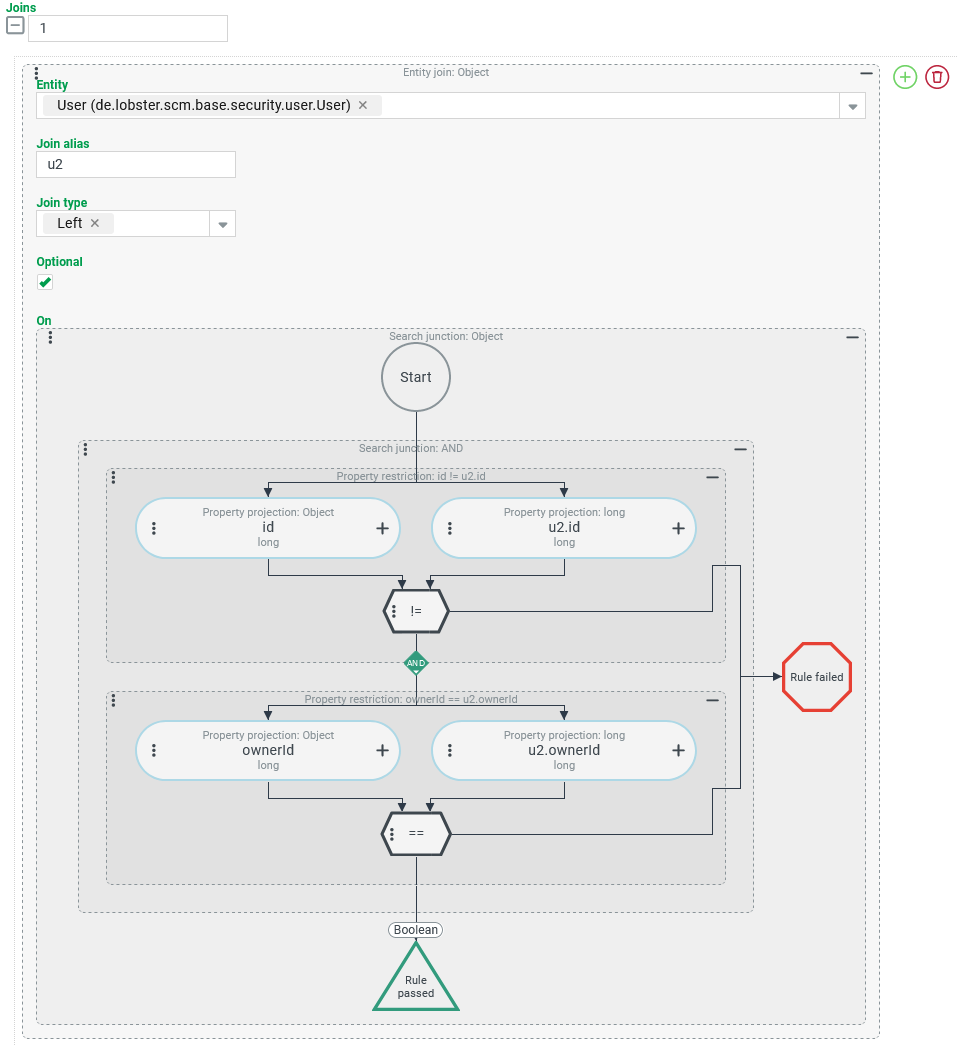 |
| --- | --- |
| The screenshot on the right shows the [Projections](/v1/docs/en/core-i-search-projection), with which the desired result can be achieved: - The [Property projection](/v1/docs/en/core-property-projection) for the `username` column can be retained unchanged. - The [Collection projection](/v1/docs/en/core-collection-projection) for the `SAME_OWNER` column now refers as a **Property of collection** via the `u2.username` path to the "username" property of the users included via the [Entity join](/v1/docs/en/core-entity-join) (`u2`). - The default value "ID" (`id`) must be selected in the **Property to join**, as the (1:n) relationship is now created by the [Entity join](/v1/docs/en/core-entity-join). | 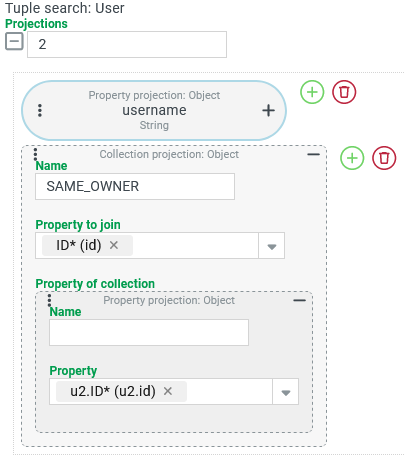 |
Runtime example:
| With the same sample data as in the previous example, the list output in the `SAME_OWNER` column now contains one entry less, because the main user now only appears in the `username` column. The result appears much clearer in a CSV search: \| ```plaintext username,SAME_OWNER bbanner,[pparker, srogers, ...] bwayne,[ckent, acurry, ...] ... ``` \| \| --- \| **NOTE:** This example also shows that the order of the list entries within the `SAME_OWNER` property is "unsorted". It is not possible to influence the order within the *collection*. Sorting according to a [Property projection](/v1/docs/en/core-property-projection) such as `u2.username` is also not helpful. On the contrary: The [Collection projection](/v1/docs/en/core-collection-projection) still returns unsorted and the sorting multiplies the output lines (user x u2) although the option **Optional** is selected in the [Entity join](/v1/docs/en/core-entity-join) (`u2`) (see above). | ```xml username SAME_OWNER - bbanner
- pparker srogers ...
- bwayne
- ckent acurry ...
... ``` |
| --- | --- |
| ```plaintext username,SAME_OWNER bbanner,[pparker, srogers, ...] bwayne,[ckent, acurry, ...] ... ``` |
### More complex example: For each user, list the account numbers of the companies that can be selected when logging in
A tuple search for [Users](/v1/docs/en/base-user) should display the account numbers of all companies that can be selected as [Company of session](/v1/docs/en/base-session-company-account-value) when logging in in a list column for each user.
Configuration:
The [Users](/v1/docs/en/base-user) search uses a [Entity join](/v1/docs/en/core-entity-join) for the "Company account" entity, which assigns the company accounts referenced in the "Companies" (`companies`) property to each user account under the alias name `ca` (for `CompanyAccount`).
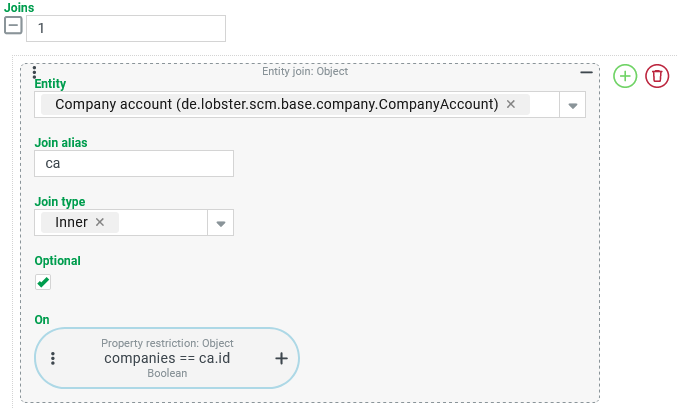
The address field "Account number" (`address.accountNumber`) is transferred to a list from the data of the company accounts assigned via [Entity join](/v1/docs/en/core-entity-join) using [Collection projection](/v1/docs/en/core-collection-projection):
| The [Collection projection](/v1/docs/en/core-collection-projection) shown on the right for the list column with the **Name** ("CA_ACC_NUMBERS") uses a property projection with the path `ca.address.accNumber` specified in the **Property to join** parameter to directly access the "account number" property of each company that the [Entity join](/v1/docs/en/core-entity-join) (`ca`) assigns to the respective user account With this configuration, the *collection* does not provide any references to companies for which no "account number" information is available. | 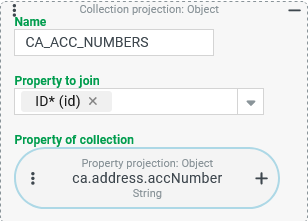 |
| --- | --- |
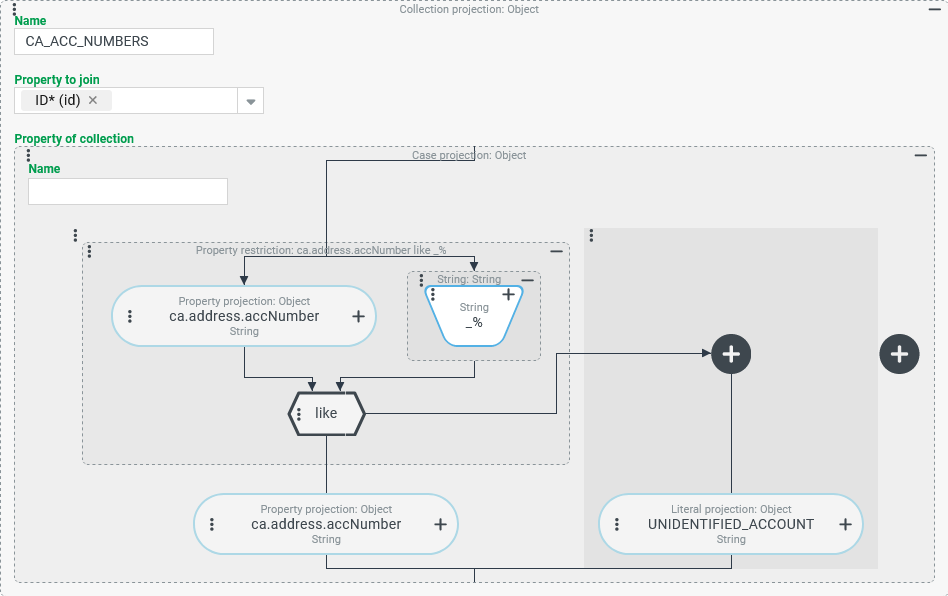
The [Collection projection](/v1/docs/en/core-collection-projection) should now be adapted so that the text "UNIDENTIFIED_ACCOUNT" appears in the CA_ACC_NUMBERS property if a company without an account number is assigned to a user:
- Specifically, the "account number" should be considered completed if it contains at least one arbitrary character. Within a [Case projection](/v1/docs/en/core-case-projection) for the **Property of collection**, a [Field restriction](/v1/docs/en/core-property-search) defines the *condition* `like _%`.
- If the "account number" is filled in (left *branch* of the case differentiation), the return value (as above) is passed directly from the [Property projection](/v1/docs/en/core-property-projection) for the path `ca.address.accNumber`.
- If the "account number" is not filled in (right *branch* of the case differentiation), the static text `UNIDENTIFIED_ACCOUNT` is assigned as the return value via a [Literal projection](/v1/docs/en/core-literal-projection).
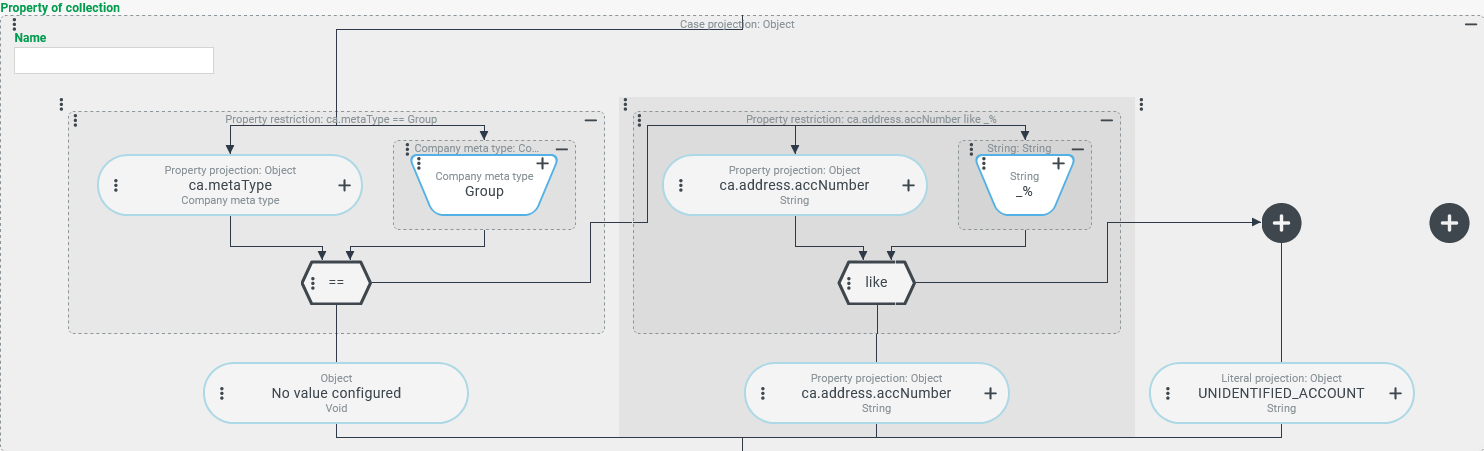
Based on the existing configuration, it should now be prevented that the *collection* in the `CA_ACC_NUMBERS` list column takes into account company accounts in whose account the "Metatype" property refers to the [Company meta type](/v1/docs/en/base-company-meta-type) "Group" (`GROUP`).
- The "group" company accounts should explicitly not be filtered out in the [Entity join](/v1/docs/en/core-entity-join) so that their data can be output separately in the [Collection projection](/v1/docs/en/core-collection-projection) for a further list column.
The following screenshot shows an additional *branch* in the [Case projection](/v1/docs/en/core-case-projection) for the **Property of collection**, in which the "meta type" of the company (`ca.metaType`) is evaluated before all other conditions in order to assign "no value" (`$null`) if the [Company meta type](/v1/docs/en/base-company-meta-type) "Group" (`GROUP`) is present.
- If "no value" (`$null`) is assigned as the return value, neither any assigned "account number" nor the `UNIDENTIFIED_ACCOUNT` text appears in the *collection*.