---
title: "Changelog"
slug: "core-create-change-log-resolver"
updated: 2026-04-16T14:04:30Z
published: 2026-04-16T14:04:30Z
canonical: "docs.lobstersoftware.com/core-create-change-log-resolver"
---
> ## Documentation Index
> Fetch the complete documentation index at: https://docs.lobstersoftware.com/llms.txt
> Use this file to discover all available pages before exploring further.
# Changelog
> [!NOTE]
> **Value resolver – Abstract**
>
> **Purpose:** Creates a *changelog* that determines the differences between an object passed as an *input value* and a parameterized *compare object* and outputs them in structured form – as a "change log".
>
> > [!TIP]
> > Tooltip
> >
> > - **Usage**: The object in the *input value* is compared with the *compare object* determined depending on the **Compare value** parameter.
> > - If differences are detected, they appear in a changelog in the return value, whose type depends on the type of *input value*.
> > - If no differences relevant to the parameterization are found, the return value is "no value" (`$null`).
> >
> > - **Parameter**:
> >
> > ---
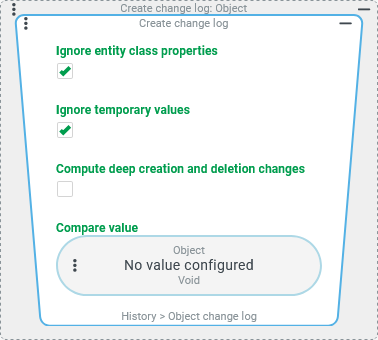
> > - The **Ignore entity class properties** option is checked by default. If there is an entity as *input value*, its *entity attributes* (`created`, `creatorId`, `lastModified`, `lastModifierId`, `ownerId`, etc.) will be ignored during the comparison if the option is checked.
> > - The **Compute deep creation and deletion changes** option is unchecked by default. For deleted and created values (objects), only the minimum amount of information appears in the return value.
> > - A configuration for the **Compare value** is optional.
> > - For an *entity* as *input value*, the "original object" is used as default *compare object* without configuration.
> > - For all other object types a **Compare value** should be explicitly configured, otherwise "no value" (`$null`) will be returned.
> > - **WARNING:** In connection with hierarchical objects, the generation of a changelog can require a considerable "computing effort" and can create extensive amounts of data.
---
**IMPORTANT:** This value resolver is not available in a [Client Workflow](/v1/docs/en/frebehav-client-workflow)!
---
The [Change log](/v1/docs/en/core-create-change-log-resolver) value resolver generates a *changelog* that determines the differences between an object passed as *input value* and a *compare object* defined by the **Compare value** parameter and outputs them in a structured form – as a "changelog".
The type of the return value depends on the type of the *input value.*
| Input value type | Examples | Return value type | Specific fields |
| --- | --- | --- | --- |
| **Simple value** | Text values, numeric values, enumeration values, etc. | "Changelog > Simple value" (`SimpleValueChangeLog`) | `fromValue`, `toValue` |
| **Collection** | List, Unique list, etc. | "Changelog > Collection" (`CollectionChangeLog`) | `fromLength`, `toLength` |
| **Entity** | Business object, [Custom type definitions](/v1/docs/en/custom-custom-type-definition), Line item, Configuration, Attribute implementation (see also table below), etc. | "Changelog> Entity" (`EntityChangeLog`) | `fromId`, `toId` |
| **Other objects** | Client object, date value, date range, attribute (see also table below), etc. | "Changelog > Object" (`ObjectChangeLog`) | `fromClass`, `toClass` |
**IMPORTANT:** Technically, each changelog type offers the fields `fromIndex` and `toIndex`, which refer to the sequence position within a *collection*. These fields contain the value `-1` if the index is not applicable (due to lack of reference to a *collection*).
**NOTE:** Changes to attributes of an entity can be determined in different ways. The return value type varies:
| Input value for the changelog | Input value type | Return value type | Specific fields |
| --- | --- | --- | --- |
| **Attribute owner** *Parent* entity of the attribute e.g. a business object or also a line item | Entity | "Changelog > Entity" (`EntityChangeLog`) for the attribute owner, which contains one of the following change log types for each attribute that has been changed: - "Changelog > Singular attribute" (`SingularAttributeChangeLog`) - "Changelog > Plural attribute" (`PluralAttributeChangeLog`) - "Changelog > Typed attribute" (`TypedAttributeChangeLog`) | `attributeType` |
| **Attribute implementation** e.g. "Order > Text attribute" type | Entity | "Changelog > Entity" (`EntityChangeLog`) for an instance of the attribute implementation as a standalone entity containing the actual attribute as a value (see next line) in the `value` field. | *no attribute* |
| **Attribute** e.g. "Text attribute" type | Object | "Changelog > Object" (`ObjectChangeLog`) for the attribute containing changelogs for other types (see above) to describe the actual changes. | *no attribute* |
Compare logic:
- If no differences are found between the *input value* and the *compare object*, the return value is "no value" (`$null`).
- If no **Compare value** is configured (default) and an entity is available as *input value* at runtime, its [Original entity](/v1/docs/en/core-original-entity-resolver) (i.e. the server-side state for the entity) is used as the *compare object*. This is the typical use case for the value resolver.
- The **Ignore entity class properties** option only works in this use case. It controls whether changes to the *entity* *attributes* ("Owner", Created by", "Creation date", etc.) are ignored (default) or taken into account during a comparison.
- If the entity in the *input value* contains other entities (e.g. line items or attributes), a changelog is generated for them – recursively if necessary – which appears together with other "changes" as part of the *parent* changelog.
- If the *input value* is not an entity, but e.g. a simple value, a list or a "client object", then the **Compare value** should be configured explicitly, otherwise the *input value* is also a *compare object* and the value resolver returns "no value" (`$null`).
- If the input value is a list of entities, these will not be automatically compared with the respective [Original entity](/v1/docs/en/core-original-entity-resolver) if no **Compare value** is configured. However, if necessary, this can be achieved by explicit configuration for the **Compare value** (see *Special use case* in the "Examples" section).
- The **Compute deep creation and deletion changes** option controls how much information the changelog provides about objects that are classified as created or deleted in the context of the comparison:
- For created or deleted values, only a minimal amount of information appears by default (option unchecked).
- If the option is checked, the *changelog* will output more data of the object in question:
- An object classified as "deleted" is reproduced in its entirety with all its details.
- For an object classified as "created", its data is reflected by a "changelog" with "no value" (`$null`) as the *compare object*.
> [!NOTE]
> **IMPORTANT:** What kind of "changes" does the changelog describe?
>
> ---
>
> The *changelog* is not a chronological list of manipulations actually performed on a specific object. In fact, two objects (the *input value* and the *compare object*) are compared, which may or may not be different *versions* of the same object. Generally formulated, the "changelog" describes one or more "changes" that could transform the *compare object* into the *input value*. The *changelog* therefore describes a possible transformation from the *compare object* to the *input* *value*, without claiming that the described "changes" have taken place at all and, if exactly so.
>
> Examples illustrating the evaluation logic in the change log:
>
> - The *input value* contains a volatile dataset for any entity that has a "Name" (`name`) field. The server-side dataset (see [Original entity](/v1/docs/en/core-original-entity-resolver)) shows the text "foo" for the `name` field. In the volatile dataset, the text "bar" was assigned as "Name" during the current transaction.
> - As long as no other changes have been made to the entity in the transaction, the entity is effectively considered changed and the [Changelog](/v1/docs/en/core-create-change-log-resolver) value resolver shows the value change from "foo" to "bar" for the "Name" field.
> - As an extension to the previous scenario, the "Name" of the entity is changed back to the original value, i.e. "foo", after the change from "foo" to "bar".
> - As long as no other changes have been made to the entity in the transaction, the entity is thereby considered effectively unchanged and the [Changelog](/v1/docs/en/core-create-change-log-resolver) value resolver returns "no value" (`$null`).
> - In the *input value* there is a list with three text characters (JSON image: [`"O","X","O"`]), which as a **Compare value** is a list with the JSON image [`"O","O","O"`] contrasted.
> - Intuitively, one would perhaps expect the second value of the list to be evaluated as "changed from O to X". In contrast, the [Changelog](/v1/docs/en/core-create-change-log-resolver) value resolver shows the following "changes" accordingly:
> - The "O" at the third list position in the compare value has been changed to an "X" and moved to the second position.
> - The "O" at the second list item has been moved to the third position.
> - The final result of these operations corresponds to the *input value* as well as the change of the second position described above as "intuitive". Why is this so complicated? The value resolver determines the changes to a list according to a system that first searches the list in the *input value* for entries already "known" from the *compare object* and only then evaluates unassigned target values as "added" or "changed". The "secondary condition", intuitive for people, to get from the *compare value* to the *input value* by a minimum number of "changes", does not play any role for this algorithm.
Example of a changelog:
```plaintext
Description (original)
Description (updated)
```
- The return value of the type "Changelog > Entity" (`EntityChangeLog`) defines via the `toClass` field that a shipment (see [Shipments](/v1/docs/en/shp-shipment)) was passed as *input value* and refers to its ID (`toId`) with the value `51`.
- Since the `fromClass` and from `Id` fields do not specify any data that differs from the *input value*, the comparison apparently involves two data statuses for the shipment with ID 51. Typically, the [Original entity](/v1/docs/en/core-original-entity-resolver) serves as the *compare object* here because no **Compare value** has been configured.
- In the example, the `changeLogs` list field contains exactly one element of the "Changelog > Typed attribute" (`TypedAttributeChangeLog`) type, whose `changeType` field names the "change type" as `MODIFIED`.
- It can be seen from the `fromClass` and `toClass` fields that the `TypedAttributeChangeLog` concerns a typed text attribute – more *precisely*: its implementation – for a shipment (`ShipmentText`).
- The `attributeType` field refers to the attribute type (`TextAttribute`) used as the value, and the `type` field identifies the "Description" subtype (`DESCRIPTION`) defined as the value from the dynamic enumeration [Text type](/v1/docs/en/base-text-type) (`TextType`).
- The `changeLogs` list field within the `TypedAttributeChangeLog` element contains a "Changelog > Object" (`ObjectChangeLog`) that classifies the attribute (`TextAttribute`) as changed (`MODIFIED`).
- The `name` field here refers to the name of the `value` field in the data model of the parent `ShipmentText` object.
- The `changeLogs` list field within the `ObjectChangeLogs` contains a "Changelog > Simple value" (`SimpleValueChangeLog`) for the `textValue` field (see `name`) in the `TextAttribute` object.
- The `SimpleValueChangeLog` documents the change of the text value from "Description (original)" (`fromValue`) to "Description (updated)" (`toValue`).
---
**CAUTION****:** As the example shows, even a simple text value change within an existing typed attribute of a shipment generates a significant amount of information in the return value of the [Changelog](/v1/docs/en/core-create-change-log-resolver) value resolver.When using the value resolver, it should be borne in mind that multiple changes within complex objects (such as a business object with a position hierarchy and attributes at all levels) require considerable "computing effort" and can generate corresponding amounts of data. Often, a comprehensive [Changelog](/v1/docs/en/core-create-change-log-resolver) is subsequently evaluated specifically in order to obtain relevant information or to prepare it in a more easily "readable" form.
---
## Configuration
### "Ignore entity attributes" option
| The **Ignore entity class properties** option is checked by default. When comparing "entity data", the so-called *entity attributes* are then not evaluated. Example: The *input value* is the volatile data of a random entity, which (without configuration for the **Compare value**) is matched with the server-side data state. In the default configuration for the [Changelog](/v1/docs/en/core-create-change-log-resolver) value resolver shown on the top right, the **Ignore entity class properties** option is checked. If the only change in the entity’s volatile data is a "change of owner" – i.e. a value for the entity attribute "owner" (`ownerId`) field that has changed compared to the [Original entity](/v1/docs/en/core-original-entity-resolver), the value resolver still returns "no value" (`$null`), since the volatile data state is evaluated as unchanged despite the change. | 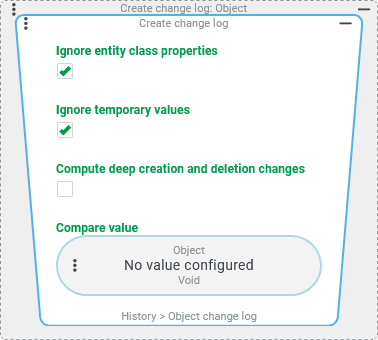 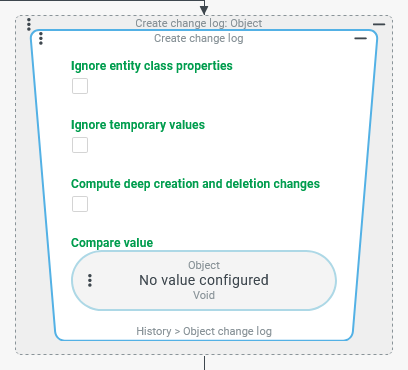 |
| --- | --- |
| If the **Ignore entity class properties** option is unchecked, then the comparison between the *input value* and *compare object* for the changelog will also include all *entity attributes*. For the above example, this means that a "change of owner" is also considered a change, so that in the return value of the [Changelog](/v1/docs/en/core-create-change-log-resolver) value resolver you will find, among other things, a `SimpleValueChangeLog` object for the `ownerId` field. |
### "**Compute deep creation and deletion changes**" option
| The **Compute deep creation and deletion changes** option is unchecked by default. If the compare value is classified as "created" or "deleted", only the minimum functionality appears in the return value of the [Changelog](/v1/docs/en/core-create-change-log-resolver) value resolver. The respective "change type" (`changeType`), i.e. `DELETED` or `CREATED` is specified in the header of the respective change log entry, without giving all details about the object. Example: The *input value* is volatile data for a company account in which the address (still) stored on the server side has been deleted. When the comparison is made with the **Compute deep creation and deletion changes** option unchecked (see screenshot above right), an `EntityChangeLog` (with the embedded address as entity) is output for the `address` field, which shows the "change type" (`changeType`) `DELETED` and identifies the deleted entity only via the `fromClass` and `fromId` fields. | 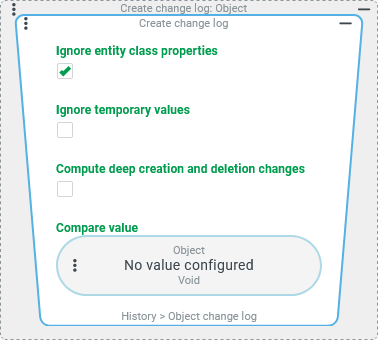 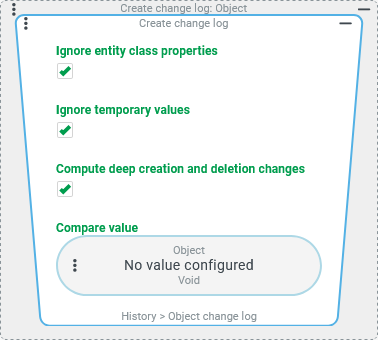 |
| --- | --- |
| If the **Compute deep creation and deletion changes** option is checked (see screenshot below right), then in the scenario described above the comparison will provide detailed information for the deleted address, which for this purpose is marked with "no value" (`$null`). The `EntityChangeLog` for the `address` field contains, in addition to the data also listed in the default case (`fromClass,fromId`) in the `changeLogs` list field, a possibly very extensive listing of child changelogs, as if each feature within the address had been deleted individually. By recursion, this also involves attributes of the address, address contacts, their attributes, etc. |
### Compare value configuration
| The optional **Compare value** parameter can be used to contrast the *input value* with a *compare object*. If a configuration for the compare value is completely omitted (default, see screenshot on the right), then the "original object" for the *input value* is used as the *compare object*. - For an entity as an *input value*, this means that a volatile and possibly changed data state is compared with the server-side state from the beginning of the transaction. - For all other *input value* types, the *input value* itself is considered as the *compare object*, so no changelog is expected. The return value is then "no value" (`$null`). |  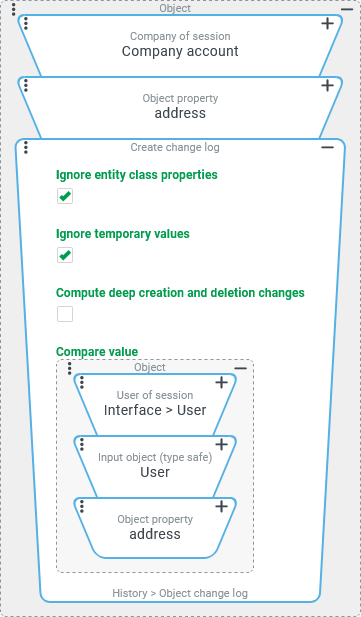 |
| --- | --- |
| In the configuration on the right, the address of the [Company of session](/v1/docs/en/base-session-company-account-value) (in the *input value*) is compared with the address specified for the [User of session](/v1/docs/en/base-session-user-value) as a *compare object*. - The company address in the *input value* is provided here by a concatenation with the [Company of session](/v1/docs/en/base-session-company-account-value) value resolver and an [Object property](/v1/docs/en/core-property-resolver) value resolver that accesses the `address` field of the company account. - In the **Compare value** parameter, starting from the [User of session](/v1/docs/en/base-session-user-value) value resolver, the [Input object (type safe)](/v1/docs/en/core-root-entity-resolver) value resolver is used to ensure that a user account (and not, for example, a guest user account) is present. Then the `address` field is accessed in the same way as the *input value*. **NOTE:** If a guest user (see [Guest users](/v1/docs/en/base-guest-user)) is logged in, the [User of session](/v1/docs/en/base-session-user-value) value resolver does not return a user account (see [Users](/v1/docs/en/base-user)). Then the concatenated [Input object (type safe)](/v1/docs/en/core-root-entity-resolver) value resolver passes "no value" (`$null`) to the [Object property](/v1/docs/en/core-property-resolver) value resolver. However, since a guest user account does not have an `address` field, this would not work anyway. If a value resolver chain is configured for the **Compare value** that returns "no value" (`$null`) at runtime, `$null` is used as the compare object. If an entity is present as *input value*, this results in an `EntityChangeLog` that evaluates the entity in the *input value* as "created" (`CREATED`). Without configuration for the **Compare value**, on the other hand, `$null` would be returned, as described above. |
## Examples
### Changelog > Simple value
*The following examples use the JSON format to describe data structures.*
| Input value | Compare value | Changelog |
| --- | --- | --- |
| "ABC" | "XYZ" | ```plaintext { "class": "de.lobster.scm.persistence.history.SimpleValueChangeLog", "fromIndex": -1, "fromValue": "DEF", "name": null, "toIndex": -1, "toValue": "ABC" } ``` |
| - For a text value (`String`), the string as a whole is considered a value (`fromValue`, `toValue`). - A comparison for the length (`length`), which is offered in the [Object property](/v1/docs/en/core-property-resolver) value resolution as a "field", does not take place, since it is a calculated quantity. - For an independent `String` the index (`fromIndex`, `toIndex`) and the name (`name`) does not matter. |
| 4711 | 3210 | ```plaintext { "class": "de.lobster.scm.persistence.history.SimpleValueChangeLog", "fromIndex": -1, "fromValue": { "class": "java.lang.Integer", "value": 3210 }, "name": null, "toIndex": -1, "toValue": { "class": "java.lang.Integer", "value": 4711 } } ``` |
| - A numerical value is considered as a value (`fromValue`, `toValue`) considering the data type (`class`). - In the example above, the sequence of digits (in JSON) for the compared values is interpreted as an `Integer`. - For an independent `String` the index (`fromIndex`, `toIndex`) and the name (`name`) does not matter. |
| *e.g. from a* [Long](/v1/docs/en/core-long-value-editor) *value resolver* | 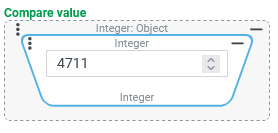 *e.g. from an* [Integer](/v1/docs/en/core-integer-value-editor) *value resolver* | ```plaintext { "class": "de.lobster.scm.persistence.history.SimpleValueChangeLog", "fromIndex": -1, "fromValue": { "class": "java.lang.Integer", "value": 4711 }, "name": null, "toIndex": -1, "toValue": { "class": "java.lang.Long", "value": "4711" } } ``` |
| - *Input value* and **Compare value** differ here only in the data type (`class`). - The `SimpleValueChangeLog` therefore registers a change of the value, but does not indicate that the `class` field has changed. |
| *Enumeration value "East" (E) from the user-defined dynamic enumeration DIRECTIONS:* *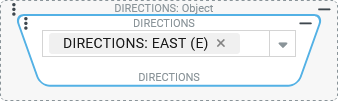* *see also* [Any enumeration](/v1/docs/en/core-any-dynamic-enum-value-editor) | *Enumeration value "North" (N) from the user-defined dynamic enumeration DIRECTIONS:* 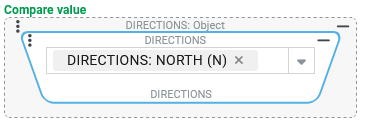 *see also* [Any enumeration](/v1/docs/en/core-any-dynamic-enum-value-editor) | ```plaintext { "class": "de.lobster.scm.persistence.history.SimpleValueChangeLog", "fromIndex": -1, "fromValue": { "class": "de.lobster.scm.denum.DynamicEnumDto", "enumName": "DIRECTIONS", "name": "N" }, "name": null, "toIndex": -1, "toValue": { "class": "de.lobster.scm.denum.DynamicEnumDto", "enumName": "DIRECTIONS", "name": "E" } } ``` |
| - The values of static and dynamic enumerations are compared as "Simple values". - For independent enumeration values the index (`fromIndex`, `toIndex`) and name (`name`) does not matter. |
### Changelog > Collection
*The following examples use the JSON format to describe data structures.*
| Input value | Compare value | Changelog |
| --- | --- | --- |
| ["Tom","Dick","Harry","Sally"] | ["Tom","Dick","Harry"] | ```plaintext { "class": "de.lobster.scm.persistence.history.CollectionChangeLog", "changeLogs": [ { "class": "de.lobster.scm.persistence.history.SimpleValueChangeLog", "fromIndex": -1, "fromValue": null, "name": null, "toIndex": 3, "toValue": "Sally" } ], "changeType": null, "fromIndex": -1, "fromLength": 3, "name": null, "toIndex": -1, "toLength": 4 } ``` |
| - An entry has been added (at the end) to a list (`List`) of text values. **NOTE:** In fact, the list in the *input value* is compared with another list in the **Compare value**, which contains the same static entries at the first three positions. A real "change" to the statically defined list (e.g. by [Modify list](/v1/docs/en/core-modify-collection-actor)) could not be examined by [Changelog](/v1/docs/en/core-create-change-log-resolver), because no [Original entity](/v1/docs/en/core-original-entity-resolver) is available as a reference. - The `CollectionChangeLog` registers the change of the length of the list (`fromLength`, `toLength`). - On the other hand, a `SimpleValueChangeLog` appears in the `changeLogs` list field, specifying the new value (`toValue`) for the added list item (`toIndex`). |
| ["Tom","Dick","Harry"] | ["Tom","Dick","Harry","Sally"] | ```plaintext { "class": "de.lobster.scm.persistence.history.CollectionChangeLog", "changeLogs": [ { "class": "de.lobster.scm.persistence.history.SimpleValueChangeLog", "fromIndex": 3, "fromValue": "Sally", "name": null, "toIndex": -1, "toValue": null } ], "changeType": null, "fromIndex": -1, "fromLength": 4, "name": null, "toIndex": -1, "toLength": 3 } ``` |
| - From a list (`List`) of text values the last entry is "removed" (see note above). - The `CollectionChangeLog` registers on the one hand the change of the length of the list (`fromLength`, `toLength`). - On the other hand, a `SimpleValueChangeLog` appears in the `changeLogs` list field, which logs the "disappearance" of the deleted list item (`fromIndex`, `fromValue`) as a value change to "no value" (`$null`). **NOTE:** It can be seen that the list position was not really assigned the value `$null` from the fact that the index (`toIndex`) changes to -1. With the list [`"Tom","Dick","Harry",null`] as *input value* the `toIndex` here would be 3 unchanged. |
| { "class": "set", "data": [ "Tom", "Harry" ] } | { "class": "set", "data": [ "Tom", "Harry", "Dick"] } | ```plaintext { "class": "de.lobster.scm.persistence.history.CollectionChangeLog", "changeLogs": [ { "class": "de.lobster.scm.persistence.history.SimpleValueChangeLog", "fromIndex": -1, "fromValue": null, "name": null, "toIndex": -1, "toValue": "Dick" } ], "changeType": null, "fromIndex": -1, "fromLength": 2, "name": null, "toIndex": -1, "toLength": 3 } ``` |
| - An entry is added to a "Set" (`Set`) (see note above). - The `CollectionChangeLog` registers the change in the length of the list (`fromLength`, `toLength`). - On the other hand, a `SimpleValueChangeLog` appears in the `changeLogs` list box, naming the additional entry (`toValue`). **NOTE:** The "Set" does not manage index numbers for the entries. Therefore, the `fromIndex` and `toIndex` fields show the default value `-1`. |
| [1,2,3] | [3,2,1,0] | ```plaintext { "class": "de.lobster.scm.persistence.history.CollectionChangeLog", "changeLogs": [ { "class": "de.lobster.scm.persistence.history.SimpleValueChangeLog", "fromIndex": 3, "fromValue": { "class": "java.lang.Integer", "value": 0 }, "name": null, "toIndex": -1, "toValue": null }, { "class": "de.lobster.scm.persistence.history.SimpleValueChangeLog", "fromIndex": 2, "fromValue": { "class": "java.lang.Integer", "value": 1 }, "name": null, "toIndex": 0, "toValue": { "class": "java.lang.Integer", "value": 1 } }, { "class": "de.lobster.scm.persistence.history.SimpleValueChangeLog", "fromIndex": 0, "fromValue": { "class": "java.lang.Integer", "value": 3 }, "name": null, "toIndex": 2, "toValue": { "class": "java.lang.Integer", "value": 3 } } ], "changeType": null, "fromIndex": -1, "fromLength": 4, "name": null, "toIndex": -1, "toLength": 3 } ``` |
| - Two lists with static `Integer` values are compared. All values in the *input value* also appear in the **Compare value**, but in a partially different order. The **Compare value** contains an additional element (`0`) in the last position. - The `CollectionChangeLog` registers on the one hand the change of the length of the list (`fromLength`, `toLength`). - The `changeLogs` field shows changes per `SimpleValueChangeLog` for the following list items: - The last position (`fromIndex 3`) is considered changed to "no value" (`$null`), which means it is deleted. This can also be seen from the change of the index. - The value 1 is considered "moved unchanged" to the first position in the *input value* (`toIndex 0`). - The value 3 is considered as "moved unchanged" to the last position in the *input value* (`toIndex 2`). **NOTE:** The value 2 does not appear in the `changeLogs` field because it is considered completely unchanged. |
| **Special use case: Compare all entities in a list** |
| *A collection created with the* [Create list](/v1/docs/en/core-create-list-resolver) *contains volatile data from different entities that may have changed from the server-side state:* 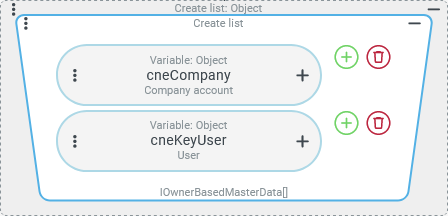 - The first list element defined is the value of a `cneCompany` variable that refers to a specific company account (see [Companies/Clients](/v1/docs/en/base-company-account) accounts). - The second list element is the value of a `cneKeyUser` variable that refers to a specific user account (see [Users](/v1/docs/en/base-user)). Both accounts have already been created and may have been changed in the current context. The [Changelog](/v1/docs/en/core-create-change-log-resolver) value resolver should detect any "volatile" changes to the accounts listed as entities. | 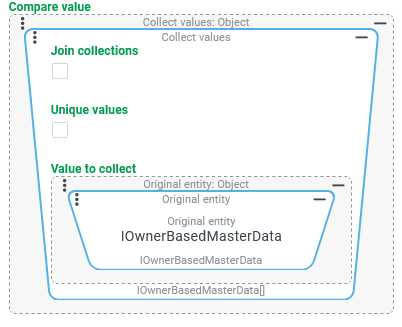 As a **Compare value**, the list of entities in the *input value* is contrasted with a list of the associated "original objects". This can be achieved with the [Collect values](/v1/docs/en/core-collect-resolver) value resolver, which here uses the [Original entity](/v1/docs/en/core-original-entity-resolver) value resolver as the **Value to collect** in order to retrieve the server-side state for each element of the list of entities present as *input value*. | ```plaintext { "class": "de.lobster.scm.persistence.history.CollectionChangeLog", "changeLogs": [ { "class": "de.lobster.scm.persistence.history.EntityChangeLog", "changeLogs": [ { "class": "de.lobster.scm.persistence.history.SimpleValueChangeLog", "fromIndex": -1, "fromValue": true, "name": "active", "toIndex": -1, "toValue": false } ], "changeType": "MODIFIED", "fromClass": "de.lobster.scm.base.security.user.User", "fromId": "1901", "fromIndex": 1, "name": null, "toClass": "de.lobster.scm.base.security.user.User", "toId": "1901", "toIndex": 1 } ], "changeType": null, "fromIndex": -1, "fromLength": 2, "name": null, "toIndex": -1, "toLength": 2 } ``` |
| - The `CollectionChangeLog` (right) lists only a single entry in the `changeLogs` field, which affects the user account at the second list position. - The `changeLogs` field in the `EntityChangelog` for this list entry indicates that the value for the `active` field has changed from `true` to `false` . This means the user account should be be disabled. - No changes appear to have been made to the company account. |
### Changelog > Object
*The following examples use the JSON format to describe data structures.*
| Input value | Compare value | Changelog |
| --- | --- | --- |
| ```plaintext { "class": "de.lobster.scm.utils.date.DateTime", "dateValue": "...", "timeZone": "Europe/Berlin" } ``` *A "Date with time" object determined as* [Relative date with time](/v1/docs/en/core-date-time-value)*:* 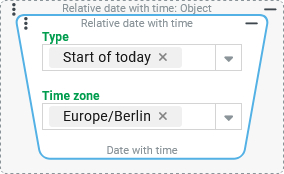 - "Start of today" in the **Time zone** `Europe/Berlin` . | ```plaintext { "class": "de.lobster.scm.utils.date.DateTime", "dateValue": "...", "timeZone": "Europe/Rome" } ``` 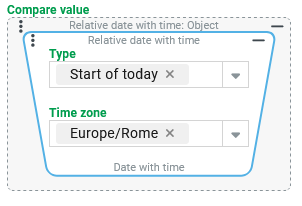 - "Start of today" in the **Time zone** `Europe/Rome`. | ```plaintext { "class": "de.lobster.scm.persistence.history.ObjectChangeLog", "changeLogs": [ { "class": "de.lobster.scm.persistence.history.SimpleValueChangeLog", "fromIndex": -1, "fromValue": { "timeZoneId": "Europe/Rome" }, "name": "timeZone", "toIndex": -1, "toValue": { "timeZoneId": "Europe/Berlin" } } ], "changeType": "MODIFIED", "fromClass": "de.lobster.scm.utils.date.DateTime", "fromIndex": -1, "name": null, "toClass": "de.lobster.scm.utils.date.DateTime", "toIndex": -1 } ``` |
| - Since the data type "Date with time" is defined in **Lobster Data Platform/Orchestration** as an object with the `dateValue` and `timeZone` fields, the comparison between two date values by [Changelog](/v1/docs/en/core-create-change-log-resolver) value resolver results in an `ObjectChangeLog`. - In the example, the "Start of next day" is compared for two different time zones. Since the compared time zones have the same offset from UTC, the compared objects differ only in the `timeZone` field, while the `dateValue` field shows the same numerical value for the milliseconds since 01.01.19700 00:00:00.000 (UTC) in both cases. |
| ```plaintext { "name": "Darth Vader", "nickname": "Dee-Vee" } ``` | ```plaintext { "name": "Anakin" } ``` | ```plaintext { "class": "de.lobster.scm.persistence.history.ObjectChangeLog", "changeLogs": [ { "class": "de.lobster.scm.persistence.history.SimpleValueChangeLog", "fromIndex": -1, "fromValue": "Anakin", "name": "name", "toIndex": -1, "toValue": "Darth Vader" }, { "class": "de.lobster.scm.persistence.history.SimpleValueChangeLog", "fromIndex": -1, "fromValue": null, "name": "nickname", "toIndex": -1, "toValue": "Dee-Vee" } ], "changeType": "MODIFIED", "fromClass": "flex.messaging.io.amf.ASObject", "fromIndex": -1, "name": null, "toClass": "flex.messaging.io.amf.ASObject", "toIndex": -1 } ``` |
| - Two "client objects" are compared with each other. - The `ObjectChangeLog` evaluates the object state in the `changeType` field as "changed" (`MODIFIED`). - In the `changeLogs` field two changes are shown by `SimpleChangeLog`: - The `name` field is evaluated as changed from "Anakin" (`fromValue`) to "Darth Vader" (`toValue`). - The `nickname` field, which occurs only in the *input value*, is evaluated as changed from "no value" (`$null`). |
| ```plaintext { "name": "Luke", "tools": { "class": "list", "data": [ { "skill": "TheForce™" }, { "item": "LightSaber™" } ] } } ``` | ```plaintext { "name": "Luke" } ``` | ```plaintext { "class": "de.lobster.scm.persistence.history.ObjectChangeLog", "changeLogs": [ { "class": "de.lobster.scm.persistence.history.CollectionChangeLog", "changeLogs": [ { "class": "de.lobster.scm.persistence.history.ObjectChangeLog", "changeLogs": [ ], "changeType": "CREATED", "fromClass": null, "fromIndex": -1, "name": null, "toClass": "flex.messaging.io.amf.ASObject", "toIndex": 0 }, { "class": "de.lobster.scm.persistence.history.ObjectChangeLog", "changeLogs": [ ], "changeType": "CREATED", "fromClass": null, "fromIndex": -1, "name": null, "toClass": "flex.messaging.io.amf.ASObject", "toIndex": 1 } ], "changeType": null, "fromIndex": -1, "fromLength": 0, "name": "tools", "toIndex": -1, "toLength": 2 } ], "changeType": "MODIFIED", "fromClass": "flex.messaging.io.amf.ASObject", "fromIndex": -1, "name": null, "toClass": "flex.messaging.io.amf.ASObject", "toIndex": -1 } ``` |
| - Two "client objects" are compared with each other. - The `ObjectChangeLog` evaluates the object state in the `changeType` field as "changed" (`MODIFIED`). - The `changeLogs` field of the (outer) `ObjectChangeLog` contains a `CollectionChangeLog`, because an additional list field `tools` was detected in the `input value`*.* - The `changeLogs` field of the `CollectionChangeLog` contains two `ObjectChangeLog` instances that record no details about the added "tools" other than the list position (`toIndex`) and the "change type" (`CREATED`). **NOTE:** Obviously the [Changelog](/v1/docs/en/core-create-change-log-resolver) value resolver was used here without selecting the **Log details for deleted and created values** option. Otherwise, the return value would also contain information about the object fields (`skill` and `item`) as `SimpleValueChangeLog` in the `changeLogs` field of the respective `ObjectChangeLog`. |
## Changelog > Entity
*The following examples optionally use the XML format and the JSON format to describe data structures.*
| Input value | Compare value | Return value |
| --- | --- | --- |
| An event handling is triggered by the "Change" event (see [Common action event](/v1/docs/en/core-common-action-event)) so that it reacts to the saving of already created entities. A [Check type](/v1/docs/en/core-check-type-rule) ensures that the event action becomes active only in the context of [Association criteria](/v1/docs/en/core-association-criteria). The *input value* is always the changed volatile data of the association criterion that is saved. Before saving changes, a [Changelog](/v1/docs/en/core-create-change-log-resolver) should be created so that – depending on the type of changes – an administrator can be notified if necessary. Example: ```plaintext ``` - In the example, only one text for the "description" (`description`) field was added to the association criteria. The `EntityChangeLog` documents exactly this one change via `SimpleChangeLog` in the `changeLogs` list field. | *not configured, that is the* [Original entity](/v1/docs/en/core-original-entity-resolver) *to the entity in question* | ```plaintext { "class": "de.lobster.scm.persistence.history.EntityChangeLog", "changeLogs": [ { "class": "de.lobster.scm.persistence.history.SimpleValueChangeLog", "fromIndex": -1, "fromValue": "", "name": "description", "toIndex": -1, "toValue": "PLEASE CHECK!" } ], "changeType": "MODIFIED", "fromClass": "de.lobster.scm.association.criteria.AssociationCriteria", "fromId": "9901", "fromIndex": -1, "name": null, "toClass": "de.lobster.scm.association.criteria.AssociationCriteria", "toId": "9901", "toIndex": -1 } ``` |
| Based on the changed state of the association criteria in the previous example, the notified administrator has reviewed the association criteria and now wants to save it again with changes. The event handling reacts again and determines the changes to the association criteria via the [Changelog](/v1/docs/en/core-create-change-log-resolver) value resolver. Example: ```plaintext ``` - The `changeLog` field in the `EntityChangeLog` now lists multiple child change logs for the association criteria: - The `SimpleValueChangeLog` in the first position proves that the "description" (`description`) field has been changed again. - The `SimpleValueChangeLog` in the second position proves that the "priority" (`priority`) has been reduced from 100 to 50. - The following `ObjectChangeLog` shows a change in the "rule set" in the `rule` field of the association criteria, which can be "examined" step by step along the nesting: - The `CollectionChangeLog` affects the `rules` list field within the outer `RuleJunction`, i.e. the list of child rules within the AND conjunction (`CONJUNCTION`): - The fact that an additional element was added to this *collection* is already proven by the change in its "length" (`fromLength`, `toLength`). - For the created element, a child `ObjectChangeLog` appears for which the `changeType` field specifies the `CREATED` value. The position of the created element is also specified at this level (`toIndex`). **NOTE:** Apparently, the **Compute deep creation and deletion changes** option was also checked for the [Changelog](/v1/docs/en/core-create-change-log-resolver) value resolver, so the `changeLogs` list box contains more details of the added object: - The included `SimpleValueChangeLog` reflects the value (`2651`) assigned to the `id` field of the added [Sub criterion rule](/v1/docs/en/core-association-sub-criteria-rule) rule (`AssociationSubCriteriaRule`) in the configuration.The following screenshot below shows the rule configuration in the administrator revised state of the association criteria: 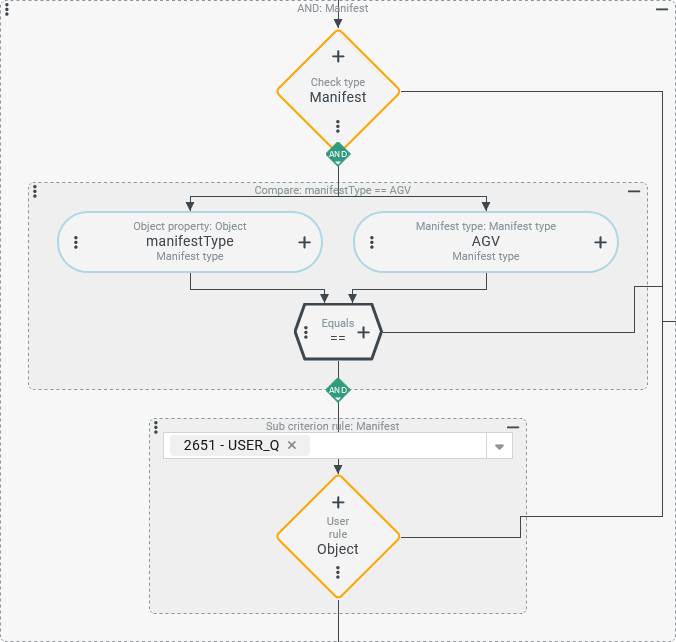 | *not configured, that is the* [Original entity](/v1/docs/en/core-original-entity-resolver) *to the entity in question* | ```plaintext { "class": "de.lobster.scm.persistence.history.EntityChangeLog", "changeLogs": [ { "class": "de.lobster.scm.persistence.history.SimpleValueChangeLog", "fromIndex": -1, "fromValue": "PLEASE CHECK!", "name": "description", "toIndex": -1, "toValue": "CHECKED AND APPROVED W/CHANGES" }, { "class": "de.lobster.scm.persistence.history.SimpleValueChangeLog", "fromIndex": -1, "fromValue": { "class": "java.lang.Integer", "value": 100 }, "name": "priority", "toIndex": -1, "toValue": { "class": "java.lang.Integer", "value": 50 } }, { "class": "de.lobster.scm.persistence.history.ObjectChangeLog", "changeLogs": [ { "class": "de.lobster.scm.persistence.history.CollectionChangeLog", "changeLogs": [ { "class": "de.lobster.scm.persistence.history.ObjectChangeLog", "changeLogs": [ { "class": "de.lobster.scm.persistence.history.SimpleValueChangeLog", "fromIndex": -1, "fromValue": null, "name": "id", "toIndex": -1, "toValue": { "class": "java.lang.Long", "value": "2651" } } ], "changeType": "CREATED", "fromClass": null, "fromIndex": -1, "name": null, "toClass": "de.lobster.scm.association.criteria.rule.AssociationSubCriteriaRule", "toIndex": 2 } ], "changeType": null, "fromIndex": -1, "fromLength": 2, "name": "rules", "toIndex": -1, "toLength": 3 } ], "changeType": "MODIFIED", "fromClass": "de.lobster.scm.association.criteria.rule.RuleJunction", "fromIndex": -1, "name": "rule", "toClass": "de.lobster.scm.association.criteria.rule.RuleJunction", "toIndex": -1 } ], "changeType": "MODIFIED", "fromClass": "de.lobster.scm.association.criteria.AssociationCriteria", "fromId": "9901", "fromIndex": -1, "name": null, "toClass": "de.lobster.scm.association.criteria.AssociationCriteria", "toId": "9901", "toIndex": -1 } ``` |