The module "ASM" (Asynchronous Sending Module) is used to transfer any number of files to a communication partner in only one session. ASM collects the files and transfers them at a defined time (specified in cron syntax). Optionally, these files can be packed in archive containers (ZIP, TAR, etc.) beforehand. The maximum number of files in a session can also be set.
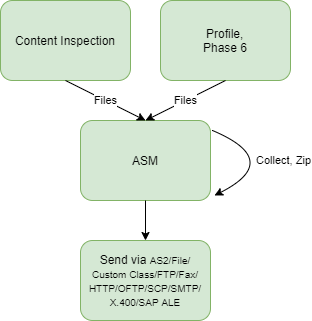
There are two ways to send data to the Asynchronous Sending Module (to an ASM entry).
With a Content Inspector (no metadata is passed).
With a Response (Phase 6 of a Profile) of types "AS2", "File", "Fax", "FTP", "HTTP", "Mail", "OFTP", "SAP ALE", "SCP" or "X.400" by directly specifying an ASM entry (metadata is passed).
Metadata contains, for example, the directory name, the file name, the control file for FTP, the file SFID for OFTP, etc. If no metadata is available for a file, default values for the transfer can be defined in the "Miscellaneous settings" of the respective ASM transmission type. These default values are only used if no metadata is available.
NOTE: There will be no metadata available when files are packed into an archive container.
The response determines how a profile sends processed data. In Phase 6, a response determines how and where the output data is sent or stored, e.g., via FTP, HTTP or e-mail. A profile can use several responses in parallel.
Responses: The profile stores the source data or sends it, for example, via FTP, HTTP, or e-mail.
A profile is the central configuration unit in the Lobster Data Platform. It receives data, processes it, and forwards it. Configuration is done graphically, with no programming required.
Communication protocol for secure EDI data exchange via HTTP/HTTPS. AS2 encrypts and signs messages and confirms receipt via MDN. AS2 is defined in the RFC 4130 standard.
Odette File Transfer Protocol. Transmission protocol for secure EDI data exchange, which is mainly used in the European automotive industry. OFTP2 complements encryption and digital signatures.
Application Link Enabling. SAP technology for the asynchronous exchange of IDocs between SAP systems or with third-party systems. Available in the Lobster Data Platform as an inbound agent and response.
SFID (Start File ID) is a start-file command in the OFTP protocol. A partner sends the SFID to announce a file transfer. It contains the originator, destination, virtual file name, file format, and options such as compression.