---
title: "core:index (Identify list entries by order position)"
slug: "orchestration-integration-control-attribute-index"
updated: 2026-04-29T06:51:51Z
published: 2026-04-29T06:51:51Z
canonical: "docs.lobstersoftware.com/orchestration-integration-control-attribute-index"
---
> ## Documentation Index
> Fetch the complete documentation index at: https://docs.lobstersoftware.com/llms.txt
> Use this file to discover all available pages before exploring further.
# core:index (Identify list entries by order position)
The control attribute `core:index` can be used in an [Import](/v1/docs/en/orchestration-integration-import) to identify the list item to be updated by its list position.
The "Index" starts from 0 and counts upwards as an integer. It is completely refreshed immediately before each access. This is particularly important if the addressed elements are to be deleted rather than updated.
Frequently, the data structure of the list item also contains its own index attribute, which, for example, in the case of typed plural attributes, is also named `index`.
| The example on the right shows an XML section of the `attributes` node of an address object: - The first two attributes are belong to a plural attribute of the "Communication info" type, which have an orderIndex attribute that specifies the order of the list entries, which (as shown here) need not correspond to the order of the nodes in the XML. --- - Below are two values of a plural text attribute of the `ACCESS_CODE`, type, which use the index attribute generated for typed plural attributes. | ```xml ... u1025@compa.ny u4252@compa.ny ABC123456789 XYZ987654321 ... ``` |
| --- | --- |
In both cases, the respective index attribute can be used to identify a specific list entry by its position during an [Import](/v1/docs/en/orchestration-integration-import).
However, in both cases the core:index attribute can be used for the same purpose to identify the list entry.
## Example 1: Updating a specific entry in a plural attribute
Address data is available for a user account as shown in the introductory example. The [Import](/v1/docs/en/orchestration-integration-import) should update a specific element listed under "communication info", namely the one with `orderIndex`=1, which appears in the second position.
| Before the [Import](/v1/docs/en/orchestration-integration-import): 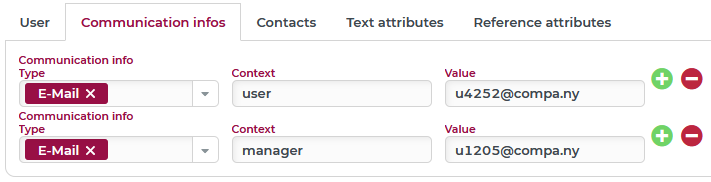 |
| --- |
| The [Import](/v1/docs/en/orchestration-integration-import) shown on the right uses the action `UPDATE`: - The user account in question is uniquely identified by ID (4252). --- - The "communication info" to be updated is only identified via the list position per core:index. The second entry is assigned a new e-mail address. | ```xml u2407@compa.ny ``` |
| After the [Import](/v1/docs/en/orchestration-integration-import): (Change by selection highlighted). 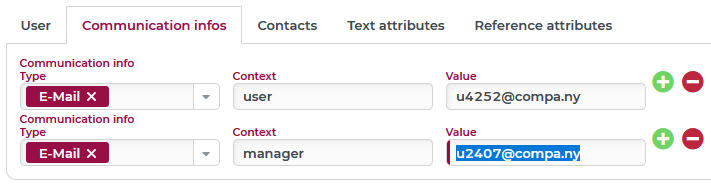 |
## Example 2: Deleting the first two entries for a typed plural attribute
Address data is available for a user account as shown in the introductory example. The [Import](/v1/docs/en/orchestration-integration-import) should delete the (first) two entries for the plural text attribute `ACCESS_CODE`.
| The [Import](/v1/docs/en/orchestration-integration-import) shown on the right uses the action `UPDATE`: - The user account in question is uniquely identified by ID (4252). --- - The text attribute `ACCESS_CODE` is addressed twice in succession with identical detail data. `The `core:delete attribute specifies the deletion. `The `core:index attribute in the `value` subnode specifies which entry should be deleted. Here the entry in the first position is deleted twice. Since the list"s index is refreshed each time it is accessed, the second entry moves up after the first one is deleted. **NOTE:** The repeated insertion of the same node in an import structure can be achieved by assigning an integer variable as a "path" for the corresponding node of the target structure, which defines the number of iterations either statically or by assignment at runtime of the profile. | ```xml ``` |
| --- | --- |
> [!NOTE]
> **NOTE:**
>
> You could try to access the two entries to be deleted in the [Import](/v1/docs/en/orchestration-integration-import) with different values for `core:index` (namely 0 and 1). In this case, the second entry would remain in the list and a third entry (if any) might move up would be deleted. If the deletions were executed in reverse order (first 1 then 0), then the deletion would be successful for both entries.