Architecture
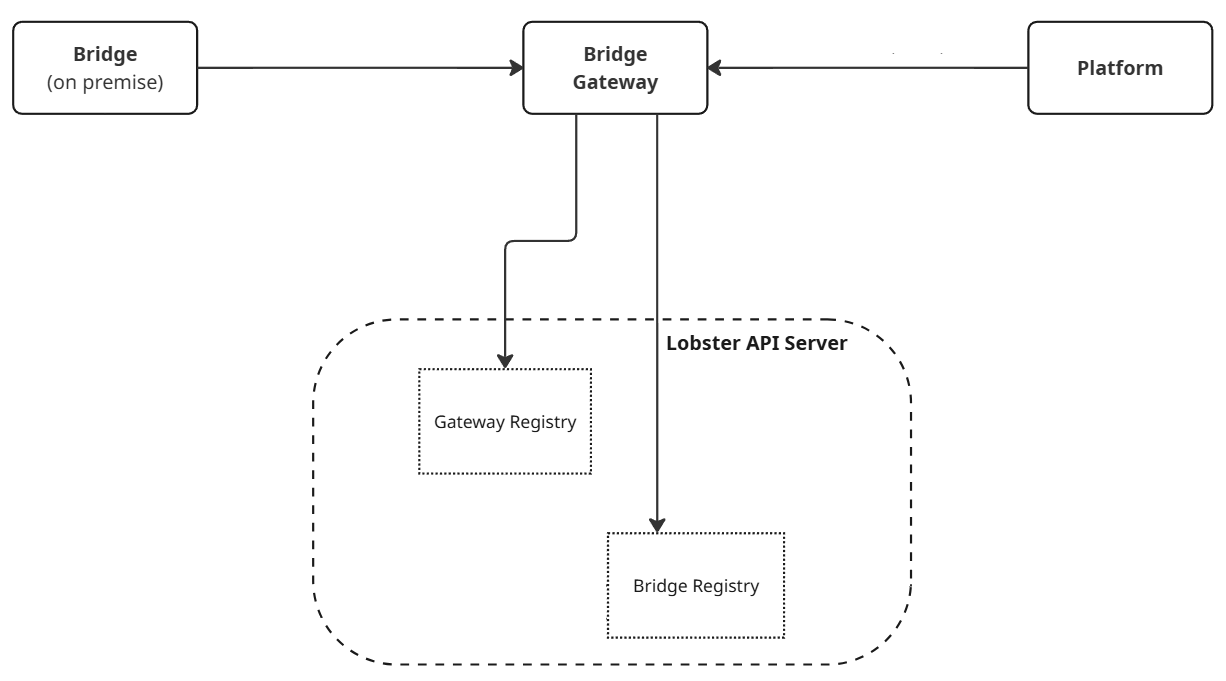
A Bridge is installed on an on-premise customer system, on which it can access local data sources (databases, files).
The bridge and the Lobster Data Platform communicate via a tunnel – the Bridge Gateway. This ensures that customer systems are not directly exposed to the Internet. By default, you can use our public gateway or a private gateway. A VPN connection is not required.
You can use multiple bridges on different systems.
The Lobster API Server hosts the Bridge Registry (which stores bridge configurations) and the Gateway Registry (stores gateway configurations). You can usually ignore that part.
Certificates
Each system (Lobster Data Platform and bridge) has its own private key and public certificate. Every HTTPS request that passes through the tunnel undergoes strict authentication, validation, and encryption via TLS protocols, ensuring confidentiality and data integrity. We refer to these certificates as the Bridge Certificate and the Platform Certificate.
Bridge data services
The bridge provides several data services to exchange data between the Lobster Data Platform and the bridge.
Database (Bridge data service): Access databases on the on-premise system (where the bridge is installed) with the Lobster Data Platform .
ETL/ELT (Bridge data service): Run ETL/ELT jobs of the Lobster Data Platform on the bridge.
AS2 (Bridge data service): Transfer files via AS2 message between the Lobster Data Platform and the bridge.