A Source tree is the source structure (of a Profile) filled with data, that is, after the process of parsing (Phase 2).
A Target tree is the target structure (of a profile) filled with data, that is, after the process of Mapping (Phase 3).
From a practical point of view, the main difference between a structure and a tree is that any node (and its fields and possibly subnodes) of a structure can occur multiple times in a tree. A tree can also contain the structure itself several times (→ records). See also: When does the parser start a new record?
NOTE: A source and target tree can consist of several records, each containing a subtree. We call the entire construct the source/target tree, i.e. starting from a (from your perspective imaginary) root we have the records and these, in turn, contain the subtrees.
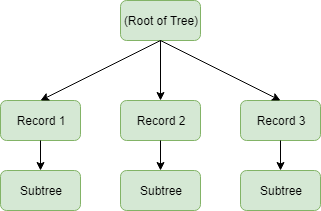
Structured representation of the input data in Phase 2. The source tree is generated by parsing the input file and forms the basis for the mapping in Phase 3.
A profile is the central configuration unit in the Lobster Data Platform. It receives data, processes it, and forwards it. Configuration is done graphically, with no programming required.
Parsing: The input data is parsed into the source structure. The source structure represents the input format.
Structured representation of the input data in Phase 3. The target tree receives the values transferred via mapping and passes them on to Phase 4, Phase 5, or Phase 6.
The core task of Phase 3. Mapping transfers data from the source structure to the target structure according to defined rules. In the process, fields can be transformed, functions can be called, and values can be calculated.
Mapping: Rules transfer the data from the source structure to the target structure. This is the core of the profile.