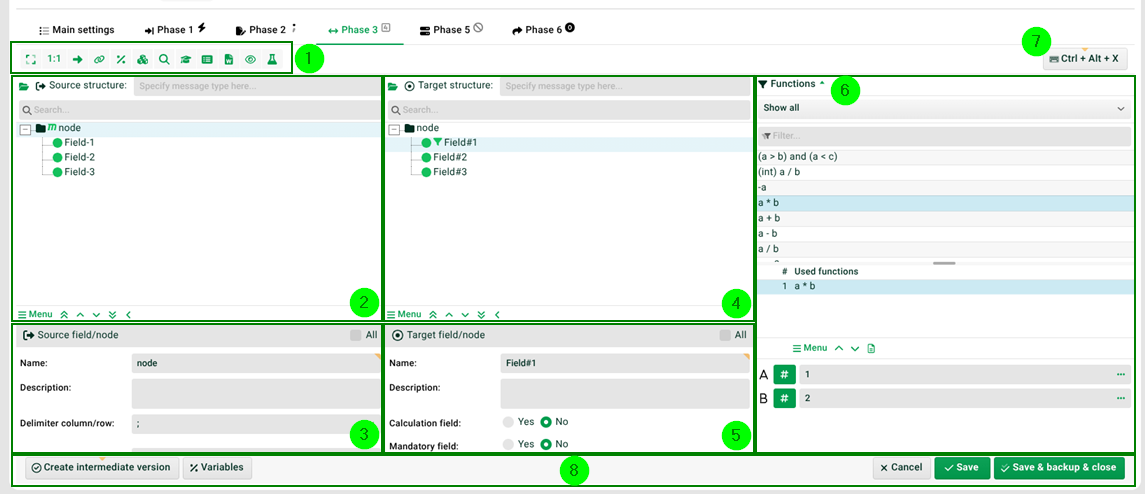
① See Top menu bar (mapping).
② See Source structure.
③ See Source structure attributes .
④ See Target structure.
⑤ See Target structure attributes.
⑥ See Functions (GUI).
⑦ Shortcut dialog, see section below. See also User menu → Settings → Main settings → Modifier keys.
(8) See General control elements.
Structure templates
See Templates for source and target structures.
Shortcut dialogue
Option | Description |
|---|---|
Focus: Source structure | Focuses the source structure. |
Focus: Target structure | Focuses the target structure. |
Focus: Functions | To edit selected functions in the target structure. |
Focus: Edit | To edit the currently selected component (field, node). |
Test mapping | Opens the Mapping test dialog. |
Restart | Opens the Restart dialog. |
Search & find | Opens the Search and find dialog. |
Create intermediate version | Creates an intermediate version of the profile, see (8). |
New field | Creates a new field. |
New node | Creates a new node. |
Cut | Fields/nodes. |
Copy | Fields/nodes. |
Delete | Fields/nodes. |
Paste | Fields/nodes. |
Find link | Finds the field from the source structure that is mapped to a selected field in the target structure. |
Paste including links | Inserts previously copied fields/nodes with mapping. |
Paste with field names as fix value | Inserts previously copied fields/nodes and gives the inserted fields the name of the copied field as a fixed value. NOTE: The inserted fields all get the data type String. |
Insert functions | Inserts previously copied functions. |
Process
As we have already seen, the parser (Phase 2) is responsible for filling the source structure with data to create the source tree.
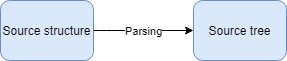
With this, you have generated the basic structure of the data on which the mapping in Phase 3 is based. The data is divided into records in the source tree and in each record you have a hierarchical structure of nodes and fields. This is always the first critical design step when you think about what your output data should look like in the end.
The mapper's task is to build a target tree from the source tree.
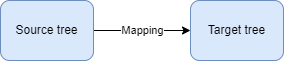
Starting from the source tree, you have two major design tools to achieve that – records and paths.