Settings
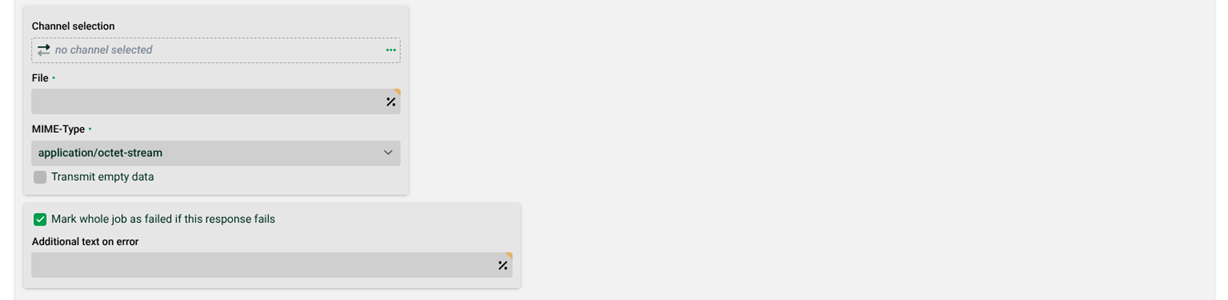
(1) Channel selection: Here you have to select a channel of type "AS4".
(2) File: Name of the output file.
(3) MIME type: The MIME type.
(4) Via DMZ: Specifies whether the sending is to be done by the Integration Server directly or via the DMZ server. If no DMZ is configured, this checkbox will not be displayed. The partner must be configured via a channel, otherwise, the checkbox will be deactivated when saving the Response.
(5) Transmit empty data: If this checkbox is set, empty files are transferred as well.
(6) Mark whole job as failed if this response fails: Normally a job is not necessarily considered to be erroneous if a single response fails (see Dependencies). But it can be enforced with this option here.
(7) Additional text on error: Here you can specify an additional log text for the error case.
A central data record in partner management that consolidates the connection parameters for a communication partner, such as the URL, access credentials, and protocol. Changes to a channel immediately affect all profiles, ASM entries, and content inspection entries that use that channel.
The successor to AS2 for secure EDI data exchange. AS4 is based on SOAP/Web Services and is the transmission standard in the EU's Peppol network as well as in the energy sector.
An optional security layer between the internet and the Integration Server. The DMZ receives incoming traffic, forwards it in a controlled manner, and protects the internal system from direct external access. When the Integration Server restarts, it buffers incoming requests.
The Integration Server is the central runtime component of the Lobster Data Platform. It executes integration processes and processes data. The Integration Server stores local certificates and uses their private keys for signing and decryption. It provides all communication services (e.g., FTP, SMTP, HTTP) and connects the application to the database. It is managed via the Admin console.
The response determines how a profile sends processed data. In Phase 6, a response determines how and where the output data is sent or stored, e.g., via FTP, HTTP or e-mail. A profile can use several responses in parallel.